
Eldritch Etchings
Gee, Eldra, why does Mother Hydra let you have two blogs?
I have two blogs:
Eldritch Etchings (you are here): general purpose posts, game reviews, and blog posts that provide my thoughts and behind-the-scenes information about the Eldritch Echoes podcast. I don’t like to give my commentary during the story videos.
Blog of Hours: Weather Factory game posts. Cultist Simulator and Book of Hours content.
I have them separated out because some people really don’t like Cultist Simulator or Book of Hours. Other people only are here for the Cultist Simulator and Book of Hours content.
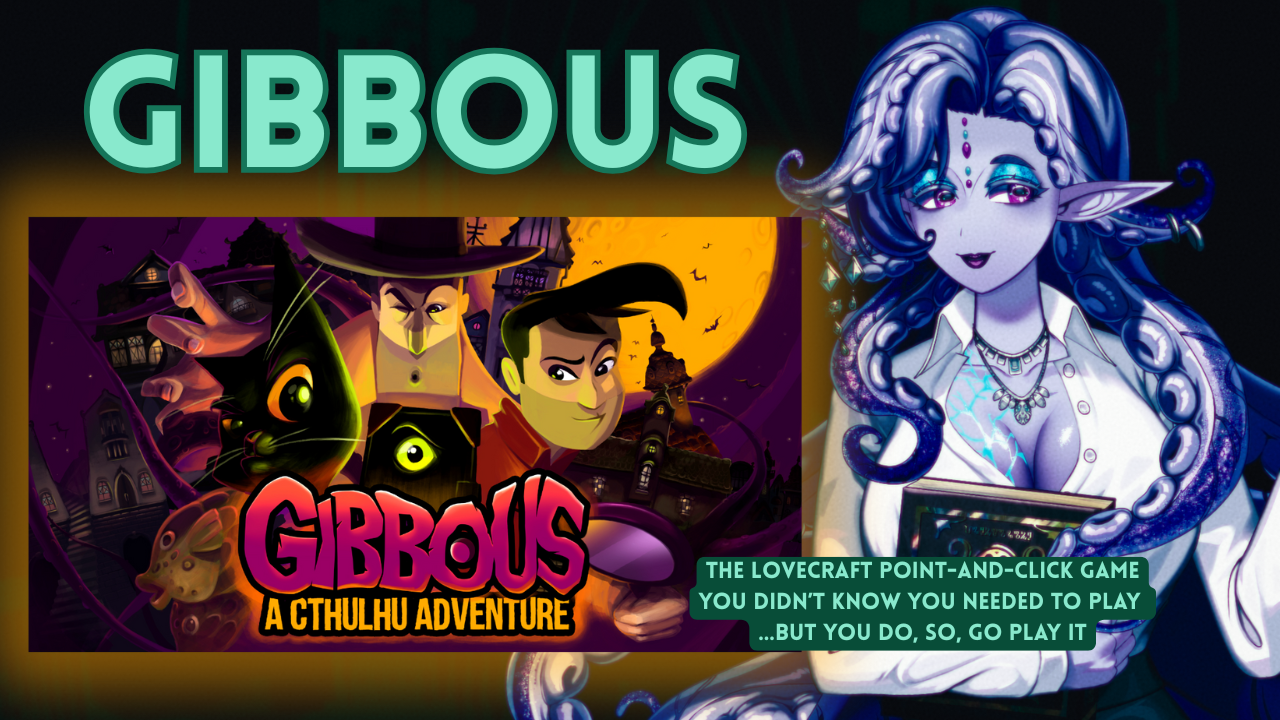
Game Review: Gibbous
TL;DR Gibbous is the Lovecraft GOTY every year
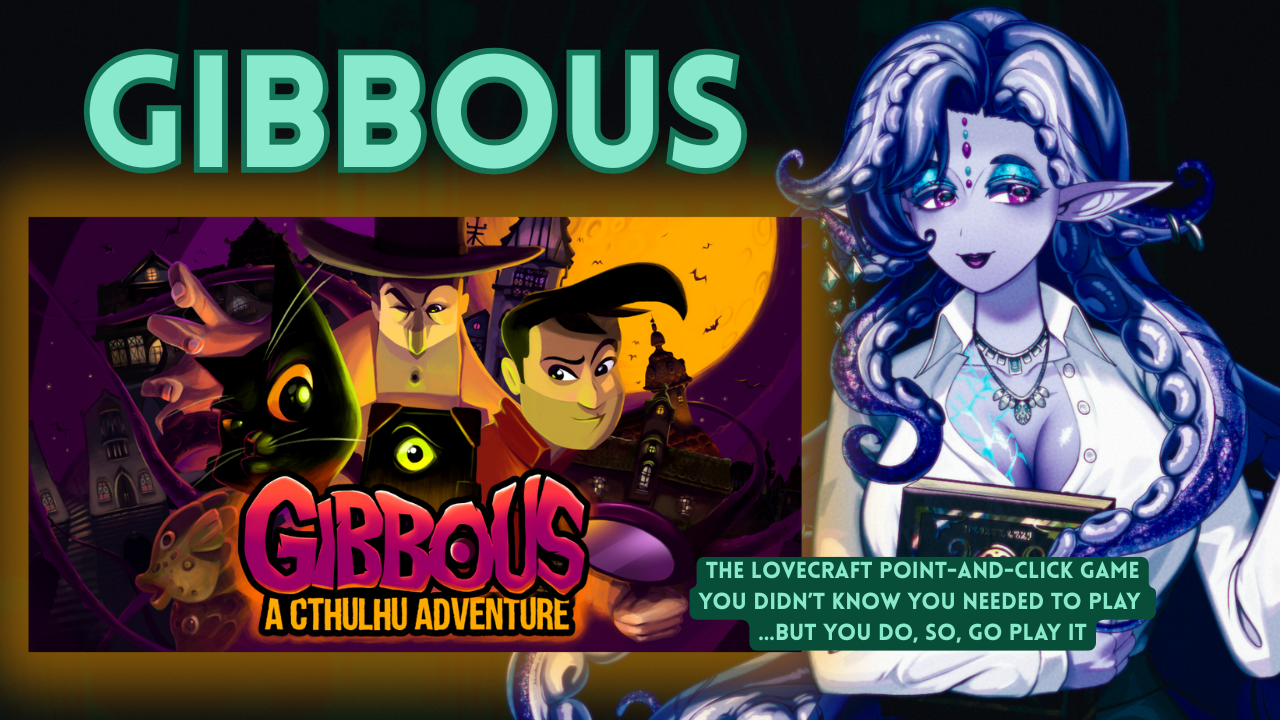
Sometimes, YouTube livestream embeds don’t work on my Squarespace site, so you can go here to watch the VOD (video on demand) of me playing “Gibbous”: https://youtube.com/live/yCjNv5pm6CE
BUY GIBBOUS
That’s the review in a nutshell.
Gibbous is a point-and-click adventure game in the classical sense, reminiscent of old-school LucasArts games, but released in 2019. It’s firmly a horror comedy game in the best of ways, with gorgeous illustrations and full voice acting.
Gibbous has everything.
Good length: It’s about 10 hours long if you don’t use guides. We used a guide for two or three puzzles because of time restrictions, but the puzzles were really fair and if you’re not trying to fit the game into a single stream, you will not need the guides.
Great voice acting. No bad voice acting to be found. There’s a lot of cut scenes, and some are really long, but I don’t find that to be a fault.
Rich world building. There’s so much content to explore and read that isn’t necessary to the basic gameplay. You can go a run without, for instance, reading all the extra files in the detective’s information cabinet, or translation a simple font cipher in Chapter 6, but all that extra content isn’t filler. It helps make the world of Gibbous feel real and lived-in through its material culture (I am not using that term correctly.)
No stand-out unfair puzzles. There are very few times where you just need to click semi-randomly to solve a puzzle. I think there were a few puzzles where you had to reinspect something multiple times to solve a puzzle, which I’m not a fan of, but it’s not egregiously unfair, and it’s not an uncommon feature in this genre of game.
Classic point-and-click adventure game gameplay. More than one (so, two) viewers commented that the game looked like something they’d play on an elementary school computer.
Good QOL features. The eye button that appears when you hover over a hotspot lets you inspect said hotspot. Some hotspots can be inspected multiple times for different text. The text cycles, and when you’ve exhausted all possible unique inspections, the eye goes from open to half-closed, but you can re-inspect the hotspots again if you want. The only thing I wish there was: a way to replay individual chapters for people that messed up specific achievements, and more autosave slots. I wanted to replay the ending and make different choices.
Beautiful, unique illustration style. It’s not quite Disney, not quite LucasArts, and there are so many great unique animations in the game, of people (and Other Things) doing so many unique things.
Unique puzzles. The puzzles and mechanics that start out Chapter 7, in particular, are very unique, as is the mechanic unlocked in Chapter 4. I don’t want to spoil it because the two sets of mechanics are really great.
Funniest Lovecraft jokes ever. The Festival chapter had me howling.
COOL ROMANIA SECTION. The devs for this game are Romanian and I love that they had a great way to show their culture in the game in a way that made sense for the plot.
Humor and horror in equal measure. The horror aesthetics comes later in the game, from about Chapter 6 onwards, but it’s very well done.
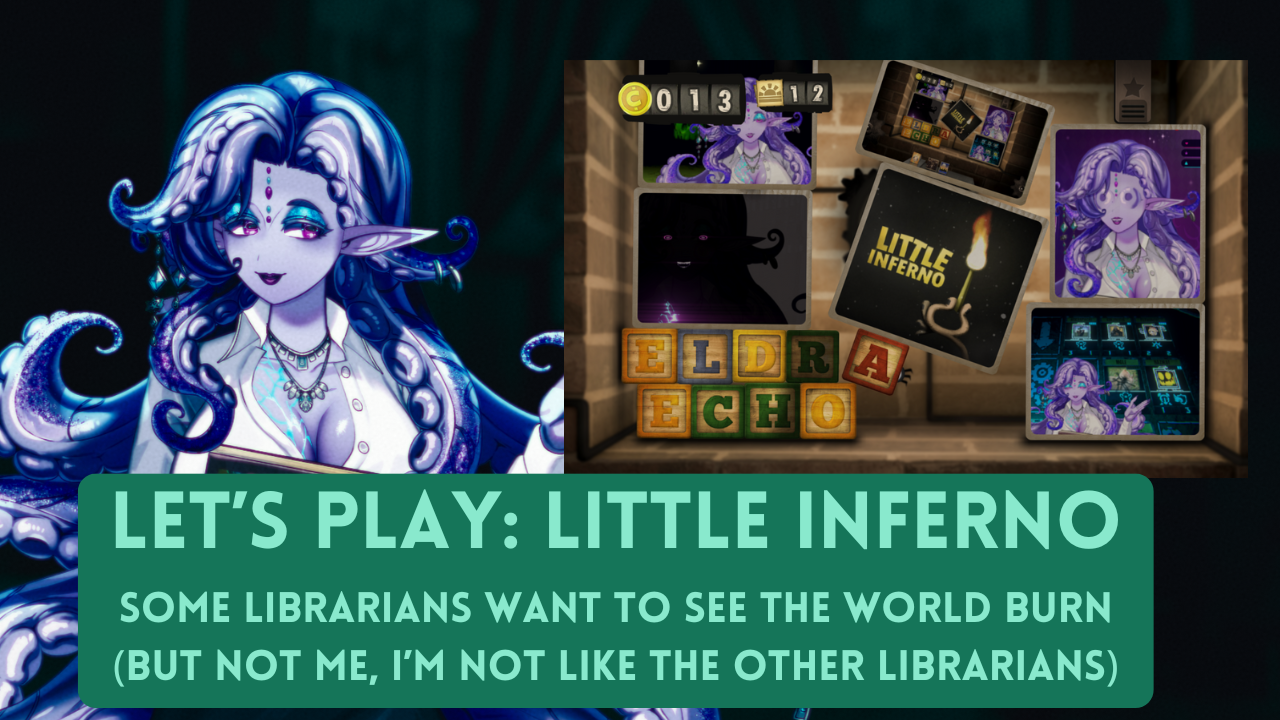
Game Review: Little Inferno
tl;dr still the best burning stuff sim in 2026
A note for streamers: This game shows your “My Pictures” folder at an early point in the game. I recommend installing the game, playing to that point (takes like 6 minutes) and seeing what folder it opens for you. Make sure you don’t have anything in there you don’t want people seeing.
I play Little Inferno every few years. This is essentially a crafting game, economy game, and cozy game for people that want to see the world burn. It was followed up by Human Resource Machine and 7 Billion Humans. The reason the Tomorrow Corporation makes unique games is because it’s literally a division of the Experimental Gameplay Group. Released in 2010, Little Inferno came out in a time when lots of independent games were focused on showcasing unique gameplay mechanics.
This is a good game for streamers who want to make memes. Have a lot of followers who will submit fanart of you they want you to burn live on stream? No safer way to do it than Little Inferno because you can import your own images into the game to use as fuel for your fire. Want to use letter blocks to spell your name and set it on fire? You can do that.
The game is relatively short, but it’s still the number one game for people that want to burn stuff up. In a world where so many games are described with a “-like” suffix (Soulslike, Roguelike, etc.,) there aren’t many Little Inferno-likes. Human Resource Machine and 7 Billion Humans are visual programming games so you’re not as likely to see me review those given those aren’t my wheelhouse.
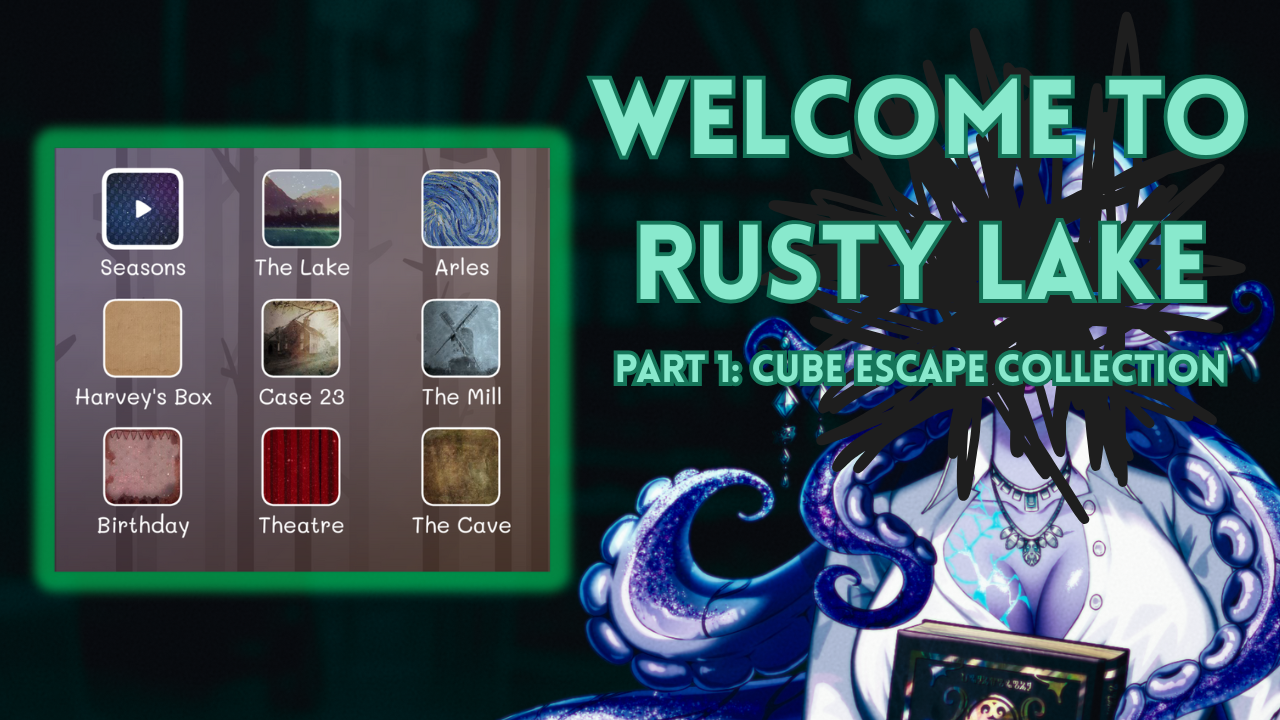
Game Review: The Rusty Lake Games
tl;dr stop reading this, just go buy The Cube Escape collection on Steam, see if you like it, buy and play Rusty Lake Hotel, Rusty Lake: Roots, and Rusty Lake Paradise in that order
tl;dr stop reading this, just go buy The Cube Escape collection on Steam, see if you like it, buy and play Rusty Lake Hotel, Rusty Lake: Roots, and Rusty Lake Paradise in that order
Note: I haven’t played any Rusty Lake games released after Rusty Lake Paradise
Just as I would if I had access to a cloning machine, I’m likely dating myself here. I grew up on an Internet where Flash games were popular, and for people who enjoyed the spookier things in life, there was nothing better than a good ol’ fashioned ‘escape the room’ Flash game. Nowadays, physical escape room experiences are more popular than the games, but they found their origins in these humble Flash games.
Note that this post contains spoilers because this game does have disturbing content.
Nobody does escape the room games better than Rusty Lake. Trust me, I’ve looked. Rusty Lake (the name of both the game studio and the series) released 100% free escape the room games via Flash game websites like Kongregate and on the mobile app stores, starting with April 2015’s release of “Cube Escape: Seasons.” With December 2015’s release “Rusty Lake Hotel,” Rusty Lake started selling premium escape the room games. These games don’t have any in-app purchases or pay-to-win/solve mechanics, don’t worry.
I started playing the Rusty Lake games when Rusty Lake Hotel was released. I played through all the available Rusty Lake games before playing Hotel. I played the next premium games, Rusty Lake: Roots, at launch. The same applies to their third premium game, Rusty Lake Paradise.
These games still hold up in 2026.
If you’re going to get into these games now, get The Cube Escape collection on Steam first and play through the games in order. There’s 9 games, of varying lengths. My stream of the games took about seven and a half hours, so without breaks, and with more smarts, it’ll likely take someone six and a half hours to beat. I think for $4.99, that’s a pretty good deal. There were only maybe 5 puzzles where I audibly said ‘that’s kinda bullshit’ in that there wasn’t a clue that would make it clear that you needed to do something. I’d say the weakest puzzles were any of the puzzles that required timing, and specifically, the cabin puzzle with a time limit for the entire level.
What makes the Rusty Lake games unique compared to other escape the room games:
Consistent worldbuilding: There is a shared world of characters, terms, and lore between the games.
Unique worldbuilding: Mixing Gothic themes, Buddhist terms, alchemy, and an art style that’s becoming increasingly rare, the world of Rusty Lake stands out.
Unique puzzles: The games don’t tend to recycle puzzles over and over like some other series do, and the puzzles presented are often puzzles I haven’t seen in any other games before.
Good balance of difficulty and fairness: There were very few times we had to look at a guide to solve a puzzle, and many of the puzzles were thinkers.
Really disturbing gameplay: We fed a dog a man’s arm to get the dog to defecate to turn the dog feces into something else via alchemy. We fed someone sandwiches filled with their own feces. A man in a well was thirsty so we gave him dog urine in a cup to drink. These are all non optional situations in the game. There’s a lot of gorgeous puzzles. There’s a good number of gross-out puzzles. If you have a light stomach, this may not be for you.
There’s replay value if…
…you want to try for different endings
…you want to try the games in different orders (e.g. release vs. in-game chronology)
…you want to do some more lorecrafting yourself
These games are weirdly enough a lot like Solitaire in that the controls are very easy and usually don’t require high reaction times, so if you have a friend who likes the type of world explored in the Rusty Lake games, and they’re not a gamer, this may be the game for them.
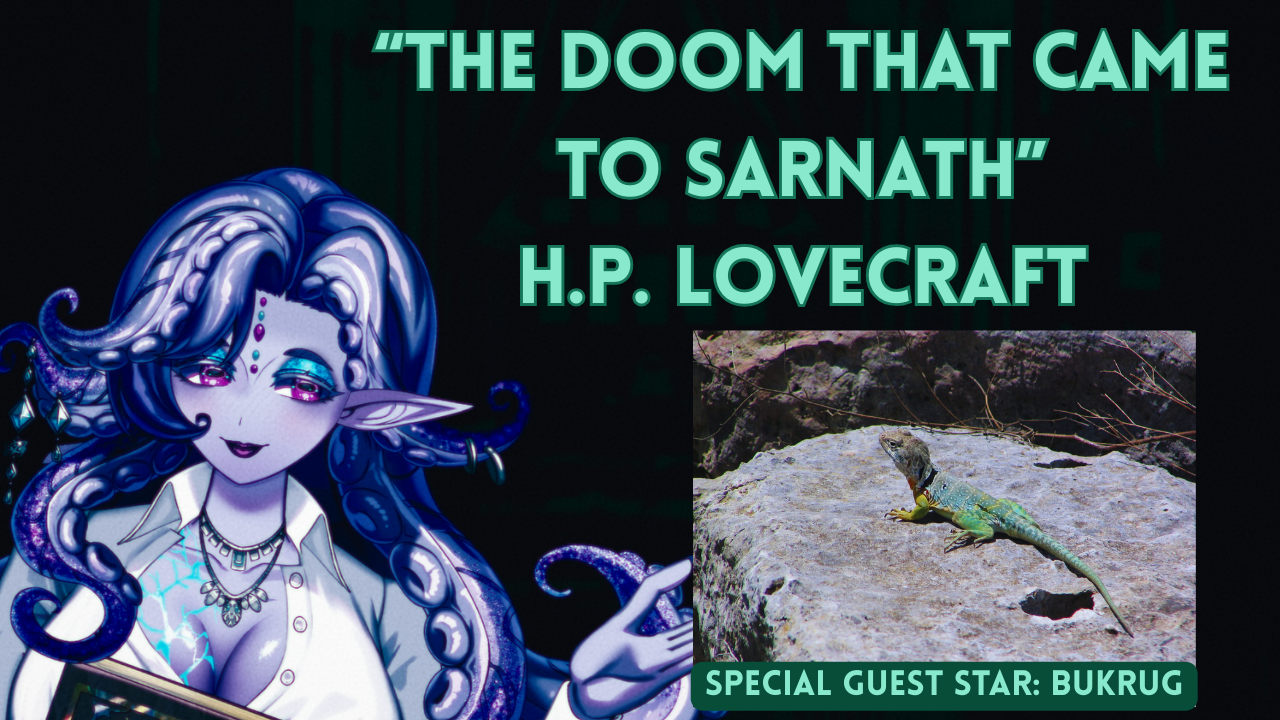
“The Doom That Came to Sarnath” by H.P. Lovecraft
Not a Dreamlands story. That’s propaganda pushed by Big Dreamlands.
My apologies for the late blog post: I was very sick, as you can hear in the tapes, but I didn’t hear no bell. I survived to tell the tale.
Fun fact: this is not actually a Dreamlands story. It's just set in the very far past. We will hear references to Sarnath in “The Nameless City,” which is clearly set in the Arabian Peninsula in the text. When setting the scene up in OBS for “Doom,” I made a desert scene, because, I thought “Okay, this is a Dreamlands story, I can make a desert set.”
It’s not a Dreamlands story
It is not set in a desert in the least
I recorded “The Nameless City” early, with my desert set, and then recorded this story. I used my aquarium scene and of course, it’s only after I record it that I find out that I could’ve also added a ruin from the Library of Congress’s archives as the backdrop. But, sometimes, you just have to hit “publish.”
I think one issue with this story is pacing. We get six paragraphs covering the events of prehistory to the fall of the Bukrug-worshippers. We get five paragraphs about the growth of Sarnath. We get six about the 1000th festival and the Doom that, like the title promises, comes to Sarnath. On paper, that’s fine: we have a third that’s an prologue of the events, a third that’s a climax/cresting of Sarnath, a third that’s an epilogue.
The pacing just feels off to me to though. I know, very academic, right? (It is not.) I will have to mull over why this is. I think it has to do with the scale of things and the descriptions of the first and final thirds being less granular than the descriptions of the middle third. I think if it were split into fifths, with the first fifth being about the lake pre-Sarnath, the second fifth being about the conflict, the third fifth about the rise of Sarnath, the fourth fifth also being about the titular doom, and the final fifth being the epilogue, the pacing would’ve been more ideal because it would have more of a focus about the actual doom that came to Sarnath, rather than the origins of Sarnath and its growth.
I can see why this work 'feels' like a Dreamlands work. Once again, Howard Philips Lovecraft mentions gold. One of these days, I need to do a post about Lovecraft stories and gold and a chart about which ones have gold. If I made a Lovecraft bingo sheet, ‘GOLD’ would be the free spot in the center. Maybe that’s a story reading idea…a bingo sheet that I do in editing in post… He mentions scenery that fits in Antiquity but also within an Orientalist fantasy -- "heels of camels from the Bnazic desert," the mentions of elephants, etc. Very luxurious!
Do you think the beings that emerged from the lake were new ones, descended from the moon, or were they the beings that had been pushed into the lake all those centuries before? Maybe a little column A, little column B?
Sorry for the unexpected 'special effects' in the background. Let me know if I messed up this file and there's any repetitions. I do all my readings in one 'cut' and rarely have to repeat anything for a second take, but if I did and forgot, let me know where the repetition is in the comments and I'll fix it.
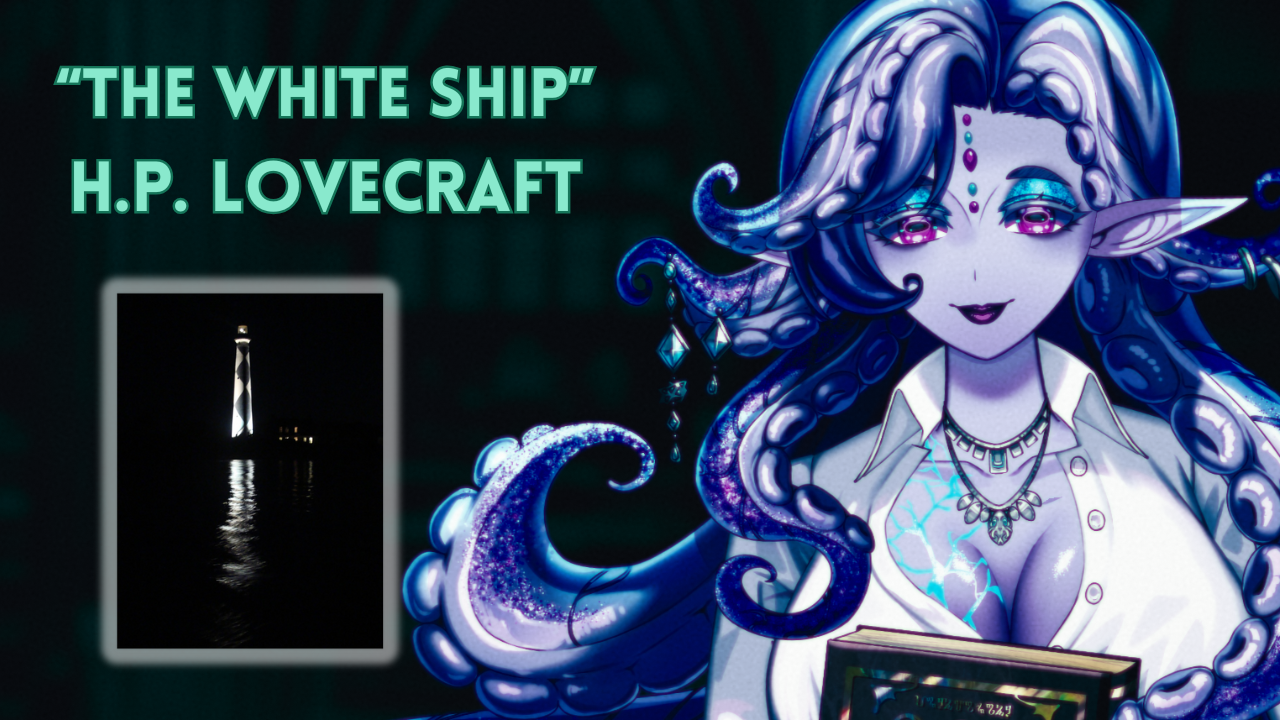
“The White Ship” by H.P. Lovecraft
Dreamlands + seafaring? Yeah, this is definitely Classical Greek-coded.
ELDRA LIVES
That cold thought it could take me down!? No, no! Of course not! Through sheer force of will — well, DayQuil (DayqWill?) — I overcame the plague and lived to tell the tale…about another tale.
“The White Ship” by H.P. Lovecraft clearly is set in the Dreamlands given it is set during a dream. I really should’ve made this video a parody of “The Lighthouse,” which I still haven’t watched because I am busy playing riichi Mahjong in Mahjong Souls. I mean, catching up on posts.
We once again see Classical imagery in the Dreamlands: pillars and whatnot. Interestingly, we also see Classical geography. The focus on the various islands draws to mind the seafaring stories of antiquity. Note the color of the ship’s sails: white sails, drawing to mind the white sails of Odysseus in The Odyssey. It draws to mind, as well, the ship of Theseus — not the philosophical problem, but Theseus’s promise to fly white sails if he slew the minotaur, black sails if he was defeated.
Similar to “Polaris,” we have disaster come at the hands of someone due to their falling asleep. The dream itself isn’t the danger — it’s that they were dreaming at all that causes a tragedy. With “Polaris,” we had a dream-within-a-dream, the protagonist failing at his task in his dream because he fell asleep in that dream.
If you liked this story, and are interested in more fantasy seafaring fiction, I highly recommend the “Abarat” series by horror author Clive Barker, who also painted lots of works for the series. The series is marked as YA, I believe, but is mature, so I’d say it’s appropriate for high school ages and up. It is not too cutesy or chintzy. It’s also a great gift for the surly teen in your life. It has literary merit, is well-written, and has lots of paintings for the more visually inclined of our group. Abarat follows a girl as she explores an archipelago where each island is based on an hour of the day, e.g. a world of eternal 8 PM, etc. Disney has the film rights and there was almost a theme park based on the series.
Also, if you don’t already use it, definitely check out the National Park Service’s online images database. They have a lot of public domain images you can use, and it’s a great way to learn more about history, find great assets you can use for free (well, your tax payer dollars paid for them…,) and a great alternative to just hoping an image is okay to use. The top three sites I use are the NPS database for nature type photos, NASA for space photos, the Library of Congress archives for other subject matter like archeological ruins, WikiArt and similar sites for public domain fine art, and Flickr for errata (you can search for public domain uploads.) Please note that these archives also include non-public domain images. I use these sites because they clearly show whether an image is public domain or not.
Note that not all Wikipedia/Wikimedia images are public domain. Ones distributed under CC 4.0-SA (Creative Commons 4.0 - Sharealike) require, for instance, that if you use the images, you only use them in works also distributed under CC 4.0 SA (requiring you also make your work okay for others to reuse and remix.) That’s a very common misunderstanding.
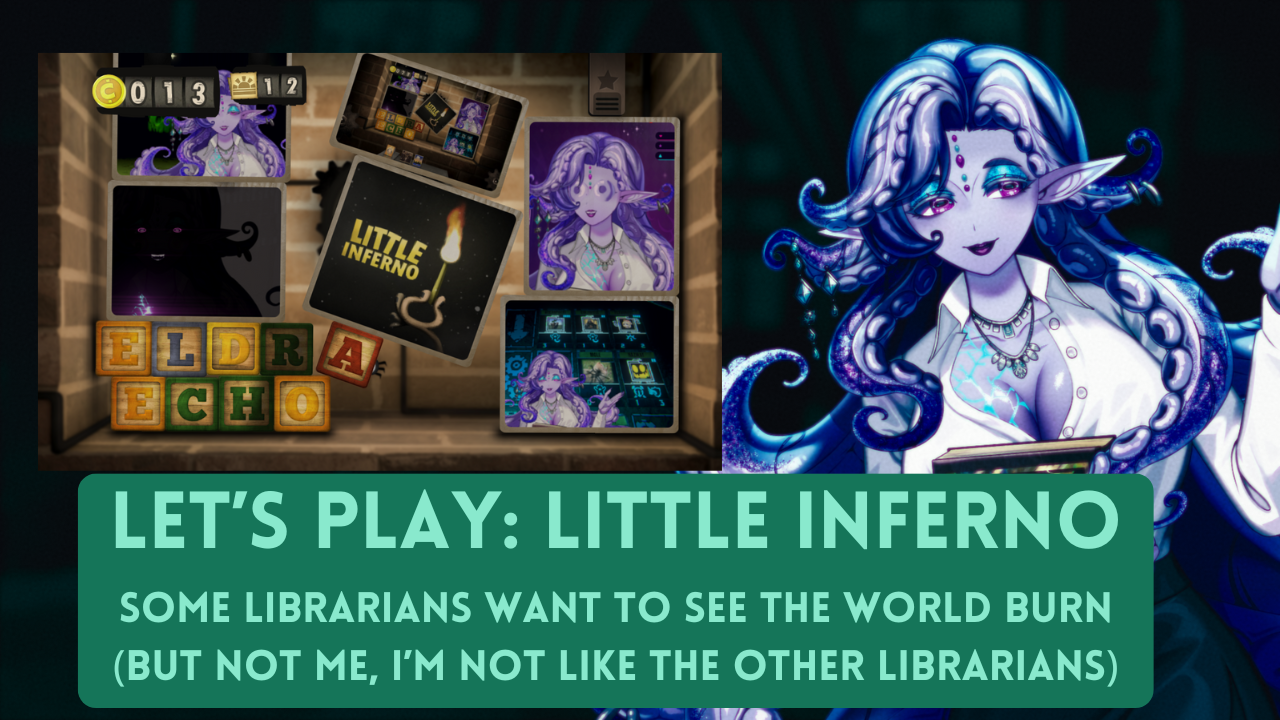
Game Review: Strange Antiquities
tl;dr play Strange Antiquities, it good
tl;dr: Strange Antiquities is better than Strange Horticulture. You do not have to play Strange Horticulture first, but they’re both great games. Pick whichever one suits your fancy, and if you’re not sure which, go with Strange Antiquities.
Strange Antiquities is the sequel to Strange Horticulture in terms of its placement in the chronology of the world of Undermere, but, as the name suggests, this game’s conceit focuses on running an occult antiquities shop rather than an occult horticulturist’s shop. The world of Undermere is transparently set in England, with references to real-world locations such as Oxford. However, unlike our world, the world of Undermere has magic. I wouldn’t call it steampunk. I wouldn’t call it arcane-punk. Think a world where lavender tea puts you to bed for magical reasons, rather than merely psychological conditioning, where rituals do indeed grant supernatural power to practitioners of certain arts, and where magic is studied with the same seriousness as any other science, with similar tools and lenses.
Note that while these games are very cozy, they are still horror games, and these ones are not necessarily appropriate for all audiences, due to some serious content and themes. It’s nothing distasteful, but it is stuff that may not be appropriate for younger children.
The gameplay loop in Strange Antiquities remains essentially unchanged from Strange Horticulture. You are essentially playing through a visual novel with the following core gameplay loop:
Customer visits shop with problem
You supply customer with an item solving their problem
Customer rewards you with more (usually) unidentifed items to use in the future, or details about items, in the form of pages of a reference text
Repeat
You start with some items and reference text pages to start. What I appreciate about this game is that not every item is identifiable in the main game nor is it necessary in the main game. There are red herrings, but most of them are fair. I think there were only four items I thought weren’t ‘ideal’ in terms of fairness.
As far as visual novels go, this has a limited number of choices that matter. The bulk of the gameplay is in paying attention, taking notes, and inventory management.
The biggest differences between Strange Antiquities and Strange Horticulture:
Game length: Strange Antiquities is about 150% the length of Strange Horticulture.* Interesting, Strange Antiquities’ main story is 17 days long, only an in-game day longer than that of Strange Horticulture, which has a main story lasting 16 days.
Numbers of tools to use: There are far more tools to use in Strange Horticulture. More books too.
Number of items to identify: There are 84 artifacts to identify in Strange Antiquities. There are 77 plants to identify in Strange Horticulture. However, because the items have far more flavor text (you can get information about an item’s material composition, appearance (e.g. color,) tactile details (e.g. temperature, rigidity,) smell, sound, and ‘vibe’ essentially) and there are more tools used for identifying items, it felt like a lot more to me.
Improved labeling symbol: more label styles, more label colors, labels can now have custom icon symbols on them
More maps: three vs. one
I’m excited to see what the next game in this series will be like. My guess? I think it’ll be based on The Twinings, the crafting workshop we encountered in Strange Antiquities. Haunted rattan chairs. Cursed wicker baskets…who knows?
*My stream of Strange Horticulture ran for 4 hours, 51 minutes. Let’s call it five hours. My stream of Strange Antiquities ran for 7 hours, 29 minutes, 52 seconds. Let’s call it seven and a half hours. I only played the base storyline, no epilogue or prologue, and did not unlock every ending, because I want to encourage people to buy the full games themselves.
Stuff I Gotta Do This Week
Stream, I have a list of games I want to stream, or, conceptions of a list
Record more Lovecraft stories, because while I was sick, I couldn’t stream and I could only record 1-2 stories a day. “The Tree” is the next story I have to record. I say it often — I am woefully terrible at languages other than English (I got an F in Old R’Lyehian, but a F stands for Ftaghn) so I am going to have to edit myself a copy of “The Tree” with the Classical terms written out phonetically. Ahhhhhhhhh so much Googling, and for some reason, a bunch of the words on Wikitionary don’t have a little voice sample!?
Go shopping on the nearest island, because I didn’t while I was sick. I got a generously sized gift card to a clothing store for Christmas so I’m going to try and get some more professional clothes.
Do writeups for my missed blog posts because I was sick.
Stream
Stream
Stream
Bother my friends on Twitter
Stream
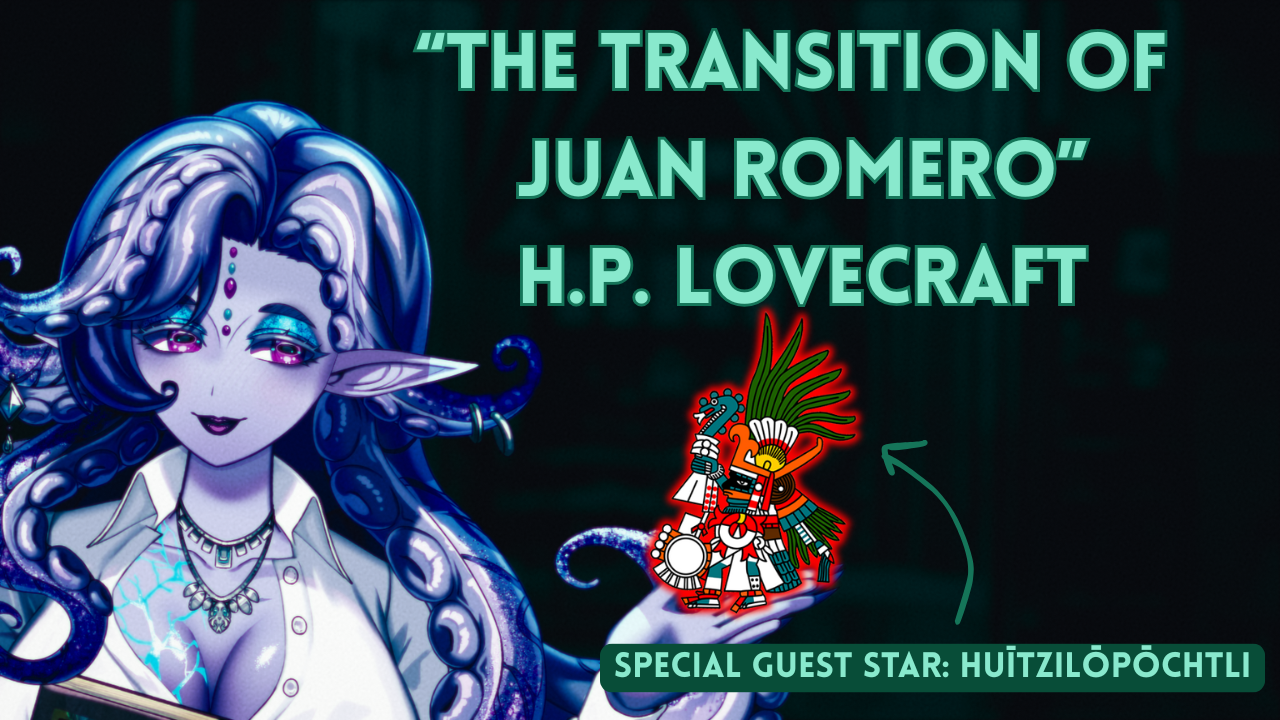
“The Transition of Juan Romero” by H.P. Lovecraft
Gold. Gods. Gaping chasms. Yep, this is a Lovecraft story.

Huītzilōpōchtli was the hardest word I've had to read in a story by Howard Philips Lovecraft so far. I listened to pronunciation sources online at least a dozen times to make sure to get it right! Huītzilōpōchtli is an Aztec god associated with war and sacrifice. I will say — given the narrator describes his own Spanish as lacking, I’m surprised the narrator would’ve realized ‘Huītzilōpōchtli’ was what was being said. If I’d written it, I would’ve had the narrator think that that there was the sound of something about wheat, a chill, a pot, and a lea. Then, the narrator, when recounting that to an audience, would be asked if he meant “Huītzilōpōchtli” and the importance of that name would’ve been explained. However, given the narrator was interested in the occult, it makes sense that perhaps he would know that name. Who am I to question the direction of Lovecraft?
Once again, we have Lovecraft's fascination with caves/tunnels and gold. The rhythmical subterranean thumping sound in “Transition” mirrors what we’re going to hear about in “The Nameless City.” I recorded “The Nameless City” early for an embarrassing reason.* (see footnote) We have so many Lovecraft games nowadays. I want one about “The Transition of Juan Romero” that features mining and dynamite and chants and gold.
Once again, we have the blurring between the dream world and reality that takes place at night. Did our narrator really go into the abyss that night, or was it all a dream? Was the narrator’s ring really of key importance that night?
It’s rather interesting that the location of the story, which some set in the American Southwest, is not the ‘home’ of Huītzilōpōchtli nor of any Hindu deities. It makes the story all rather international, highlighting the idea that cosmic beings would operate on a scale that transcends mere national, cultural, and religious borders, and may be more compatible in a syncretic fashion than one might think. It reminds me of the international spectrum, oddly, of Bram Stoker’s “Dracula” — note the usage of an American gun and the Nepali kukri by a group including Englishmen and the Dutch Van Helsing in the slaying of the Romanian Dracula on Romanian soil.
I’m surprised this isn’t one of Lovecraft’s more popular works. I think it doesn’t come off as stereotypically Lovecraftian because:
It isn’t set in New England
It doesn’t feature tentacle monsters
It doesn’t feature the ocean
It doesn’t feature cosmic entities
But, as we’ve already seen from our cursory exploration of Lovecraft, Lovecraft is more than “The Shadow over Innsmouth” and “The Festival.” The association between weird fiction and pulp fiction, between cosmic horror and adventure and detective fiction, isn’t always obvious. However, half the scenery we’ve seen Lovecraft create wouldn’t be out of place in Indiana Jones, Ducktales, or Scooby Doo, which all draw from that same pulp/adventure heritage.
A side note about Scooby Doo: if you haven’t checked out “Mysteries Incorporated,” it’s a must-see. I am not a Scooby Doo fanatic myself, but the series was wonderful. There’s only two seasons to watch. It’s “the Lovecraft Scooby Doo series.” I will avoid spoiling too much of it, but we do get cameos from Harlan Ellison (as himself,) H.P. Hatecraft (wonder who that could be a reference to?,) Twin Peaks, and it’s a great way to introduce children (maybe around age 10?) to the works of our Prince of Providence.
Video-wise, I wanted to do something fun and cave themed, but I couldn’t figure out a way to make myself look good, so I just slapped a Gameboy filter on everything using Shoost, a tool with VTS integration. VTS -> Spout -> Shoost -> Spout -> OBS. That’s the workflow.
*As you know by now, I’m releasing my Lovecraft readings in chronological order according to the order set by Donovan K. Loucks on his website Lovecraft's Fiction - Chronological Order. I’ve recorded “Transition” and “The White Ship.” So what comes next? “The Doom that Came to Sarnath.” I though “The Doom that Came to Sarnath” was set in a desert. I started the reading and realized it was not…but I already had flown to the desert so I didn’t want to waste my trip. I quickly Googled which stories were set in the desert. Obviously, “Beneath the Pyramids” is in that number. “The Nameless City” came up, so I recorded that. I still need to find a nice lake at which to film “Sarnath.”
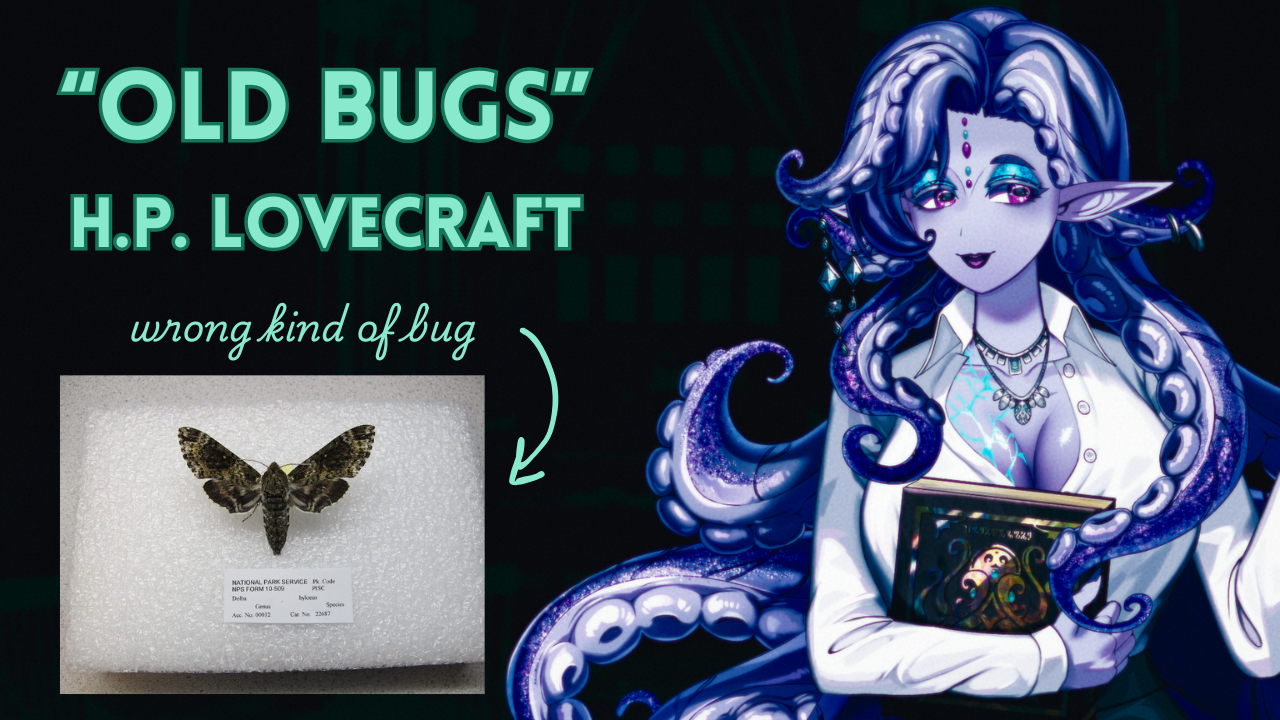
“Old Bugs” by H.P. Lovecraft
Howard Philips Lovecraft’s unofficial PSA against alcohol.
Given this was written in the early 1900s, this work's setting, of 1950, establishes "Old Bugs" as low-key a piece of speculative fiction. Howard Philips Lovecraft apparently wrote this as a very personal piece for a friend to warn them about the effects of drinking alcohol. I don't have a lot to say on this piece, unfortunately, because it's one of the works that requires the historical and biographical context I so woefully lack. My apologies. I hope you like the old-timey effects I added to the video.
I picked a picture of a moth for the thumbnail because it’s a stereotypically old bug. The National Parks gallery has a lot of great public domain image. Note that the National Parks gallery, NASA gallery, and Library of Congress galleries do not exclusively feature public domain works, so always double check the licensing of any image you want to use from those sources.
Sorry for the late blog post. I am still sick. I wanted to do a stream of “Strange Antiquities” today but I’m sniffling and sneezing every five minutes.
“Memory” by H.P. Lovecraft
tl;dr what if H.P. Lovecraft and Dougal Dixon wrote a story together? That’s “Memory.”
"Memory" is an extremely short story by Howard Philips Lovecraft. I think this counts as a work of speculative fiction. If "Man After Man" was public domain, I'd cover that.
If you like this story, I have two works I recommend you check out. Dougal Dixon is a fantastic author whose focus is on speculative anthropological evolution. Basically, he writes books about what people might evolve into. You've likely seen Dougal Dixon's work online before. I also enjoy C. M. Kosemen's "All Tomorrows" but that is also not public domain, so I highly recommend purchasing that book to support the author.
Clearly, my "makeup" for today was inspired by Georges Méliès' "Le Voyage dans la Lune" -- A Trip to the Moon. Interestingly, Georges Méliès was inspired by Jules Verne, who in turn inspired Lovecraft, who inspired me. It's all rather cyclical, isn't it? Time is a flat circle...
(This is a very short blog post and identical to the YouTube video description for now, sorry. I’m sick.)
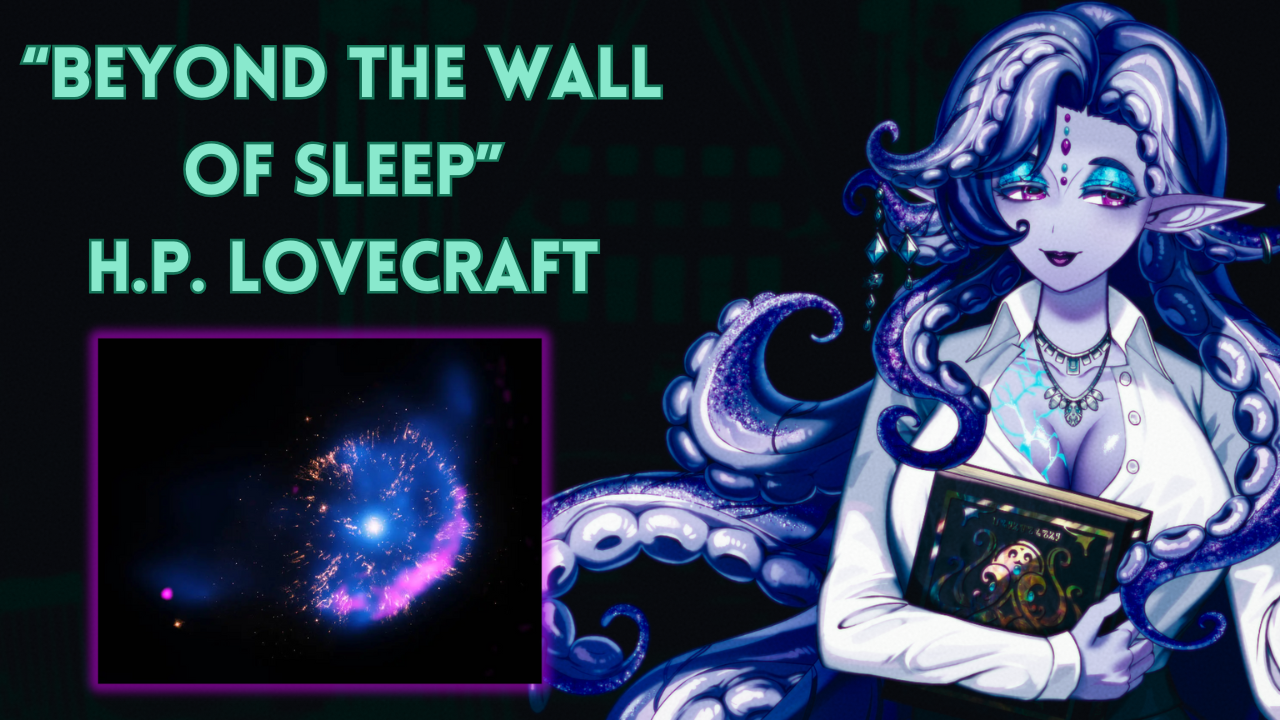
“Beyond the Wall of Sleep” by H.P. Lovecraft
GK Persei was a jerk but he wasn’t wrong.
“Beyond the Wall of Sleep” was, to put it lightly — a trip. I hadn’t actually read this story before. This story has everything:
Astral projection
Supernovae
Murder in the Catskills (putting the ‘kill’ in ‘Catskills’)
Mental institution
Weird medical shenanigans
Dreams that aren’t dreams
Unreliable narrator who violates HIPPA
I really wanted to title this video “[F4A] Unethical Psychiatrist VIOLATES HIPPA And Tells You Their Favorite Patient’s Dreams” but I didn’t want to get spanked by YouTube so I didn’t.
Similar to “Polaris,” we have two characters that live a life in the Dreamlands which seems more real than their waking lives in New England. In each case, their fantasy self is involved in a conflict of scale, is sane, is intelligent, and has a friend. I wonder if Lovecraft had similar dreams, and if it implies that he was very alone in his waking hours. I know he had correspondence with people via letters, but did he have anyone to bring him casserole when he was sick? Anyone he could go to a restaurant with? Anyone whose shoulder he could cry on?
“It is not permitted me to tell your waking earth-self of your real self, but we are all roamers of vast spaces and travellers in many ages. Next year I may be dwelling in the dark Egypt which you call ancient, or in the cruel empire of Tsan-Chan which is to come three thousand years hence.”
I am thinking this quote is actually a lot simpler than it seems.
The starguy is GK Persei. It’s 1,440 lightyears away. It takes 1,440 years for its light to reach earth. Maybe Lovecraft thought it was 3,000 lightyears away. The point is this. Let’s use Lovecraft’s number, 3000, for this.
The GK Persei supernova was observed in 1901. With Lovecraft’s reckoning, that means the supernova actually happened in the year 1099 BC. That was during the reign of Ramesses XI, an ancient Egyptian pharaoh. GK Persei, by having a vessel on earth, is able to live at two points in time: 1099 BC and 1901. And, now that he’s also living as a star in 1901, he’s got a human vessel for 4901, the far future, in “the cruel empire of Tsan-Chan.”
Basically, a lot of doubling is going on. Very Gothic application of a scientific fact which is that things take time to travel, even light. Good going, Howie.
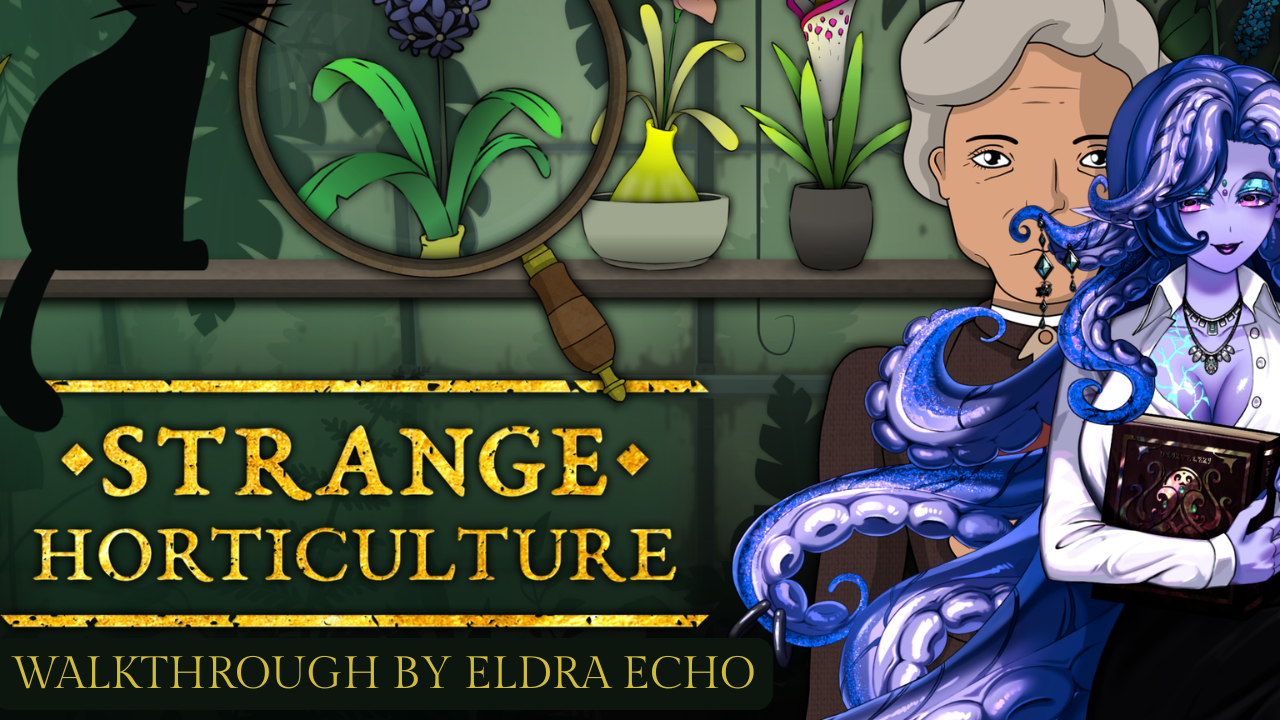
Game Review: Strange Horticulture
Strange Horticulture is a great pick for streamers who enjoy cozy, slow-placed horror puzzle games.
Strange Horticulture is the first game in the Undermere universe. Released in 2022, it was followed up by Strange Antiquities in 2025. Strange Horticulture is, essentially, a visual novel, where the choices you make are represented by plants — choosing to poison someone is done by giving them a poisonous plant, for instance. Instead of making choices through dialogue, you make choices through the plants.
This game is very cozy. There’s often rain, there’s a cat to pet that purrs, and it’s slow-paced. The core gameplay loop involves solving puzzles, getting unindentified plants or plant identification plants in return, identifying plants, rinse and repeat. You get a daily puzzle card to solve, and serve one client at a time at the shop, ringing a bell to summon customers to your counter.
There isn’t any RNG in this game. One thing I appreciate is that you do start with a bevy of plants to use as tools, and a number of pages in your herbology grimoire, which contain hints as to the identities of the unlabeled plants. However, the game doesn’t give you the opportunity to identify every single plant in a given playthrough. That’s what the epilogue and prologue (?) are for. I actually see this as a feature, not a bug. Too often, in puzzle games, is there this mindset that we fall into as a player. It’s like the Chekov’s gun law: if a gun appears, it must be used. Having a good number of the plant and identification pages not actually be relevant to the main story is realistic and means that one can’t bruteforce a puzzle by process of elimination.
My one complaint about this game is that the magnifying glass doesn’t magnify some details on the plants enough, especially the petals. If the game were to be updated, I’d love it if the index feature from Strange Antiquities were to be utilized. It could be a toggleable option in settings.
This game still holds up, 4 years after its release. Please note you do not have to play this game before you play Strange Antiquities. I recommend playing games in order, personally, but if you can only afford one, I’d actually go with Strange Antiquities. The difference is that Strange Antiquities has more tools to use to inspect items, more reference texts for you to use in-game, and it may be longer/have more items? but I’m not sure. I liked Strange Antiquities better, but by no means do I dislike Strange Horticulture.
It’s a really good game for streamers, if, like me:
You prefer slow-paced games
You like to let the audience make decisions in the game (given there’s no time limits, your chat can take their time voting in polls you set up regarding plant choices)
You prefer games that do not feature voice acting, so you can voice the characters yourself
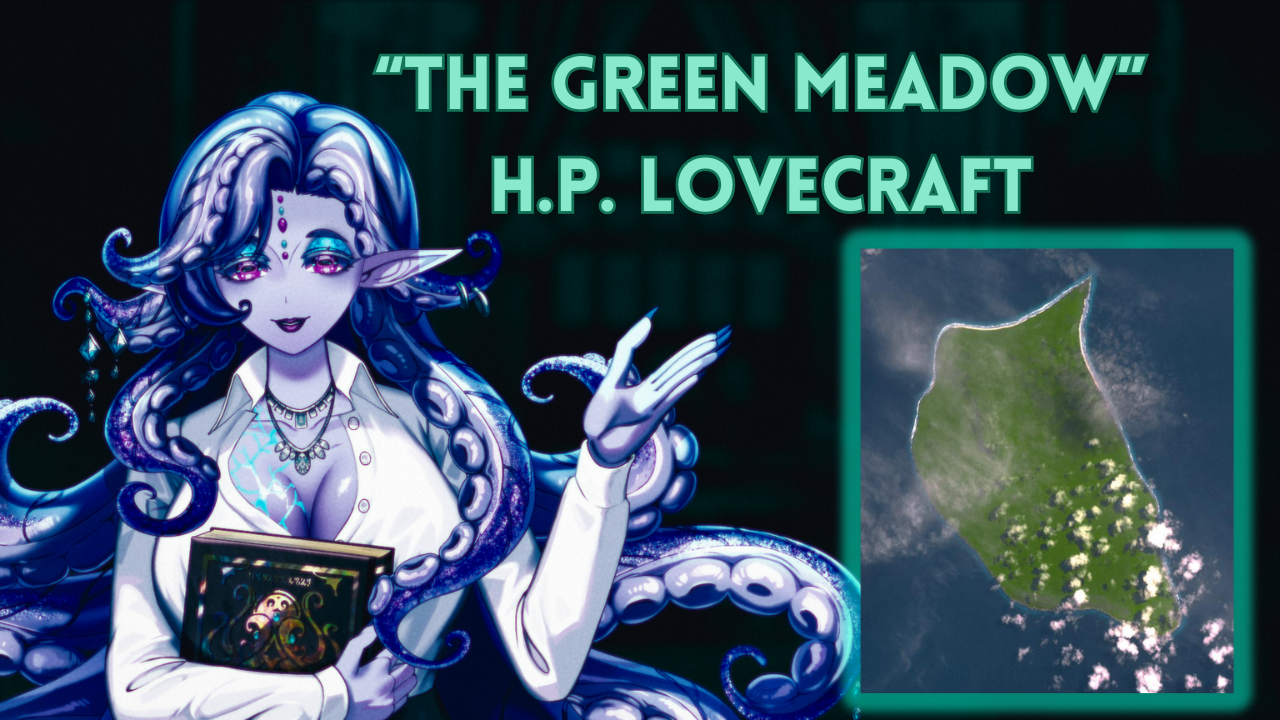
“The Green Meadow” by H.P. Lovecraft
Weird books. Weird lands. Welcome to "The Green Meadow.”
“The Green Meadow” is not one of Lovecraft’s more popular works. I think it’s for a few reasons.
The title doesn’t scream “Lovecraft”
It’s a Dreamlands story, and Yog-Sothothery is more popular, although obviously, the two are linked
No tentacles
I think it’s severely underrated and overlooked. This is one of the first stories in the Dreamlands (and thus, adjacent to Yog-Sothothery) featuring a somewhat eldritch tome. In this case, the tome’s contents aren’t unreadable (it’s been translated from Classical Greek as part of the framing narrative) and, unlike the Necronomicon, its contents aren’t necessarily occult and aren’t associated with taking a sanity loss. Instead, it’s the circumstances of the tome’s “delivery” and the composition of the material of the tome that are of particular interest — the book is found inside a meteor that is fished out of the sea in a New England town. The book is made of stone, as are its pages.
It’s one of the works where what isn’t described is what’s horrific. It’s a story that takes place in a very liminal state — a state of transition. The moving island, going between the forest and cloud. The narrator’s mindset, amnesiac but not quite fully so. There’s a stark contrast between how heavily the tome itself is described in the framing narrative and the vague contents of the story, contents that even within the framing narrative are explicitly described as vague. The framing narrative’s call to action is an imploring that anyone in the general public who can make sense of the story please do so and report their findings.
We again see some obvious classical influence here. The book-in-a-book is in Classical Greek. The narrator is stranded on an island and has lost their memory — much like Odysseus on the island of the Lotus-Eaters, although this time, the narrator is alone. “Stethelos” is clearly a name inspired by Classical Greek, bearing similarity, interestingly, to “Stethos” — breast, as in “stethoscope.” It’s rather similar to “στέλεχος” or stelechos, meaning '“stem.” It’s of course also very similar to “stylos,” as in stylus, or pen, or pillar. Apparently, Sthethelos has been adapted into Pathfinder. Please note I don’t know Greek or Latin. We’ll need Clio Aite on this one.
I picked the thumbnail because it clearly shows something akin to the setting of “The Green Meadows” — a green meadowed island in the sea, with white clouds. It’s another photo from NASA. This is what your taxpayer dollars are going towards — eldritch entities using photographs for YouTube thumbnails. My apologies.
This blog entry is late because I had to go acquire a new keyboard, my apologies!
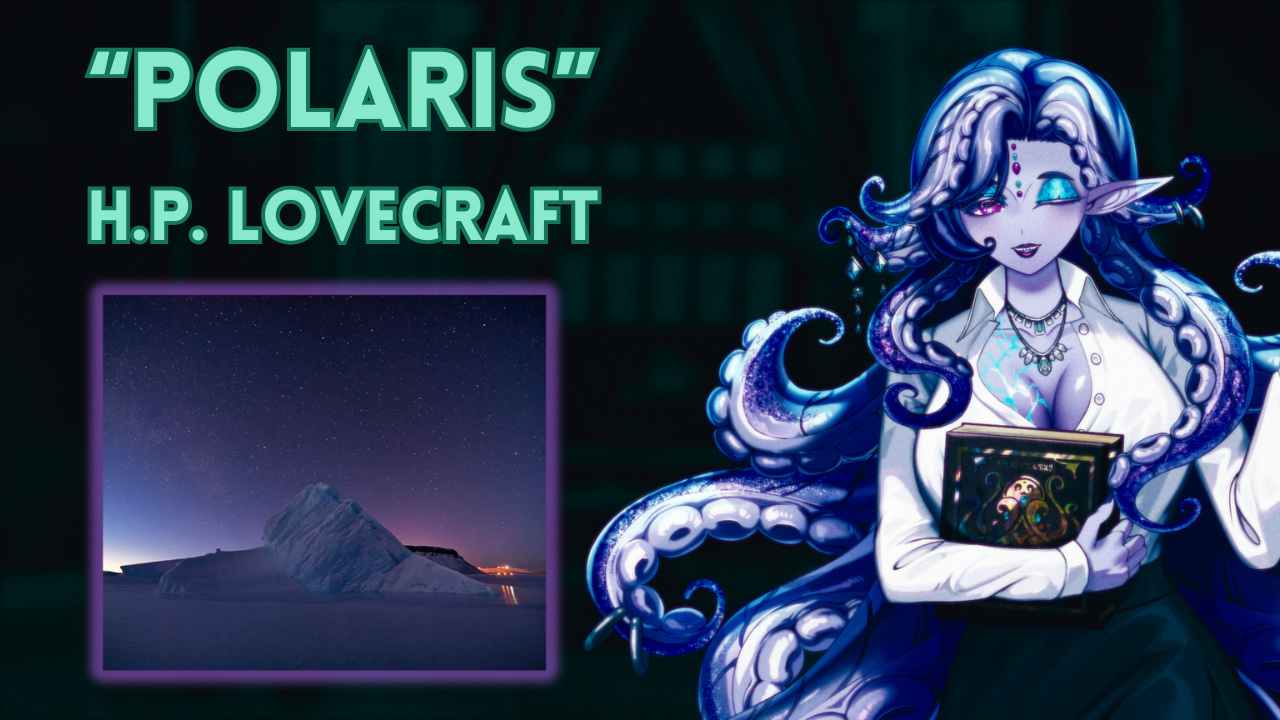
“Polaris” by H.P. Lovecraft
But, like — what if a star was evil?!
I fear my keyboard is still ‘hella busted’ and doubliing letters like this unedited sentence unfortunately shows. I am manually editing this post by hand so it will take A While to write it, unfortunately.
Polaris is clearly a story about a man who feels guilty about failing to fulfill military duty. That’s a very basic reading, and one that draws obvious parallels with Howard Philips Lovecraft’s lack of military service. This is also clearly part of Lovecraft’s ‘Dreamlands’ cycle. I am not an expert on Lovecraft’s biographical history or the Dreamlands cycle, but this story, and tomorrow’s (“The Green Meadow”) have made me realize I truly was missing out.
The Dreamland cycle seems very inspired by the Classical era — of course, classical names for stars are used, incl. Cassiopeia, and the city of Lomar is described as having marble pillars and being full of statues. The city is full of philosophers, and it’s all quite swords-and-sorcery. Perhaps the sentience and anthropomorphism assigned to Polaris is a sort of reversal of a zodiac constellation: the zodiac constellations are often times entities that have been turned(?) into stars, but in this case, the star isthe sentient entity.
Clearly, I am no Classicist. I haven’t any Greek or Latin skills. I just think it’s all quite neat.
This story very much reminds me of the famous philosophical story about Zhuangzhi and the butterfly. In the story, Zhuangzhi dreams he is a butterfly. When he awakes, he wonders if he’s a man who dreamed he was a butterfly, or, a butterfly who is dreaming that he is a man. Butterfly Dream | The Everyday Philosopher's Guide
This story is very interesting when considered in conversation with “The Shadow over Innsmouth,” which I haven’t covered yet but am familiar with. In “Shadow,” the protagonist also has a transformation to an alien state, but does so fully conscious — not in the Dreamlands. In “Shadow,” the protagonist does achieve his goal — reaching the underwater home of his ancestral line.
Today’s thumbnail photograph is from NASA: Iceberg in North Star Bay, Greenland | NASA Image and Video Library I didn’t edit the image for my thumbnail. Such a gorgeous shot. I don’t think the North Star is in the shot, but I needed something showing snow and stars. I really recommend checking out the NASA Image and Video Library, especially in a world where AI imagery is so endemic. It’s a wonderful resource for anyone interested in the stars.
It is not a picture of the North Star, but, there’s ice, there’s stars, I’m going to take what I can get, and mama needs views.
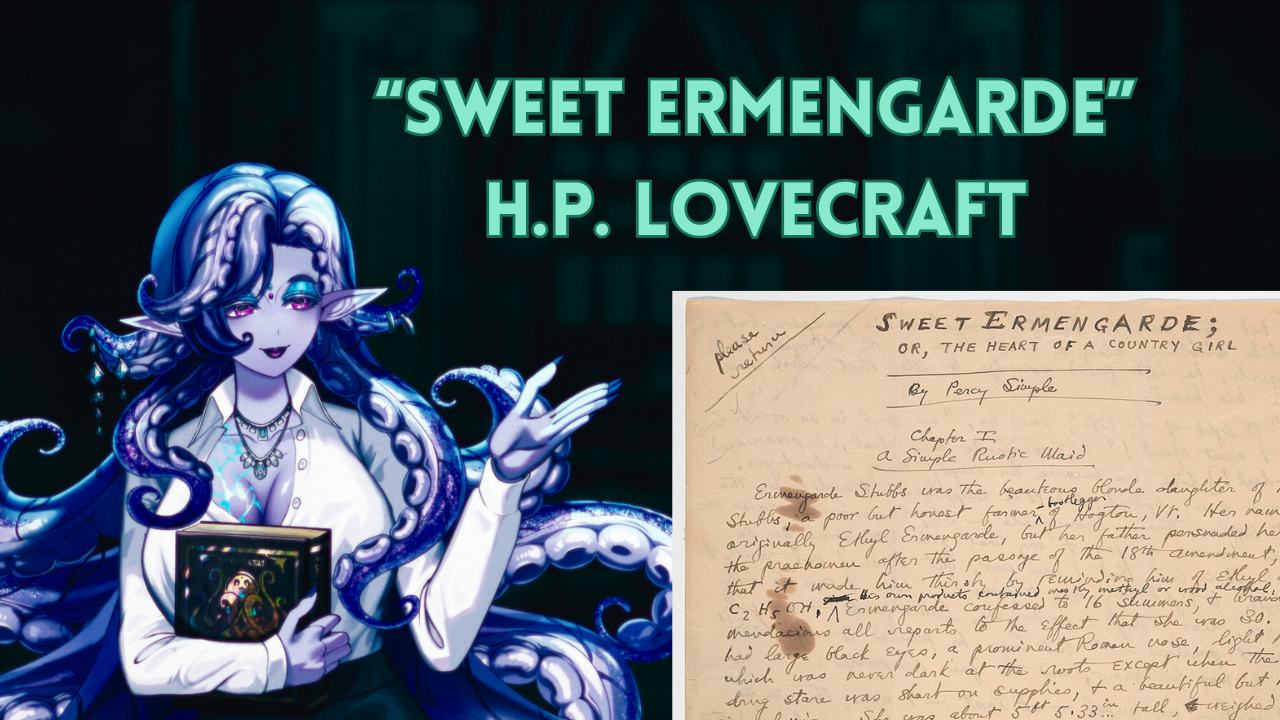
“Sweet Ermengarde” by H.P. Lovecraft
Squiire Hardmman haunted my keybboard so now I can’t write a blog post

I think this is the last of Lovecraft’s non-Lovecraftian works I’ll be covering until I get to ‘Ibid.’ I know this is likely an unpopular opinion, but I like “Sweet Ermegarde” better than I liked “A Reminiscence of Dr. Samuel Johnson.” Squire Hardman was my favorite character. I liked that he twirled his mustache and riding crop. Please note that my keyboard is having issues, so this bblog post will bbe short and I am leaving this part unedited so you can see what I mmean. My letters are randomly beiing doubled, as are my spaces and punctuation. Quite an eldritch problem to befall me, I fear. Perhaps Squire Hardman is to blame in some way…
Edit: I got a cheap keyboard at the grocery store on the nearest island. It was marked down like 50% for having a busted up box. I still want a nice Das mechanical keyboard with brown keys though. Those are my absolute favorite to work on. I left my Das on Father Dagon’s island and I can pick it up next time I emerge onto that island, which will be this year or next year.
“Sweet Ermengarde” is underrated and I guess it isn’t included in some compilation of Lovecraft’s works because it isn’t Lovecraftian, but come on. It’s hilarious.
Squire Hardman is a Scooby-Doo villain if I’ve ever seen one. The very catty lines about how Ethyl is a blonde “except when the drugstore is low on supplies” is something that I’d hear on Drag Race. It’s ‘giving’ “Great Gatsby.” We’ve got a rags-to-riches-to-richers story with a heroine whose only redeeming and arguably obvious trait is her ambition. We’ve got some almost Gilded Age drama with a wealthy older woman in the city who is lonely. We’ve got slapstick comedy abounding. This is a good story, this is a funny story, and I am both Ethyl and Hardman at heart. Maybe I’m their long lost daughter.
This story obviously has shades of “Vanity Fair” (the book, not the magazine, but I suppose the magazine as well?) and whenever I reference this to my friends, I say “Squire Hardman twirled his mustache and swung his riding crop at 7200rpm.” 7200rpm is same speed at which Lovecraft is spinning in his grave upon me writing this blog post.
Of course, we also love to see Lovecraft return to his gold grindset. Always gotta have some gold. There’s gold in them that hills, and by hills, I mean the farm and this story.
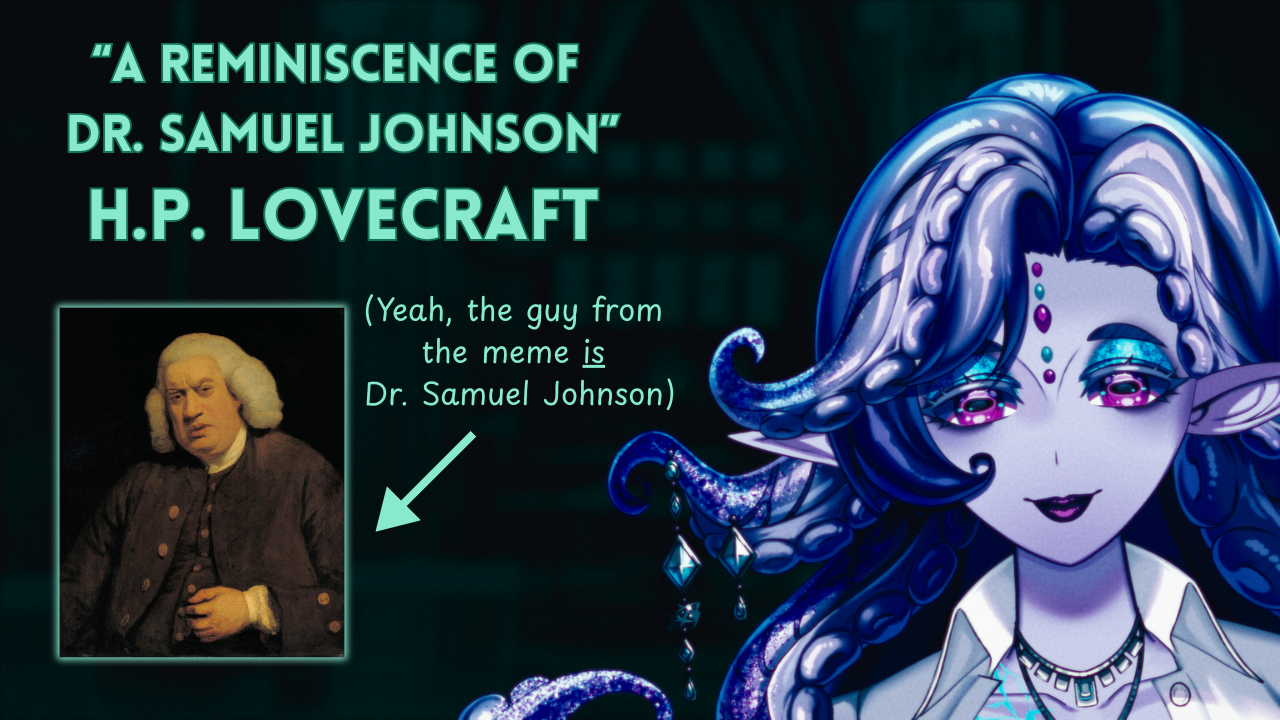
“A Reminiscence of Dr. Samuel Johnson” by H.P. Lovecraft
Samuel Johnson is that guy from the painting meme with the funky wig. That’s really all I got out of this story.

I don’t have a lot to say about this. I guess it’s a joke piece Lovecraft wrote poking fun at the way he wrote and spoke. It’s a list of stories about interactions his protagonist had with famous people. That’s it. Not a great piece, but I had to cover it for completionist reasons. I had to rerecord this multiple times because I kept stumbling on how he formatted the names ‘Thomas and Joseph’ as ‘Tho. and Jos.’
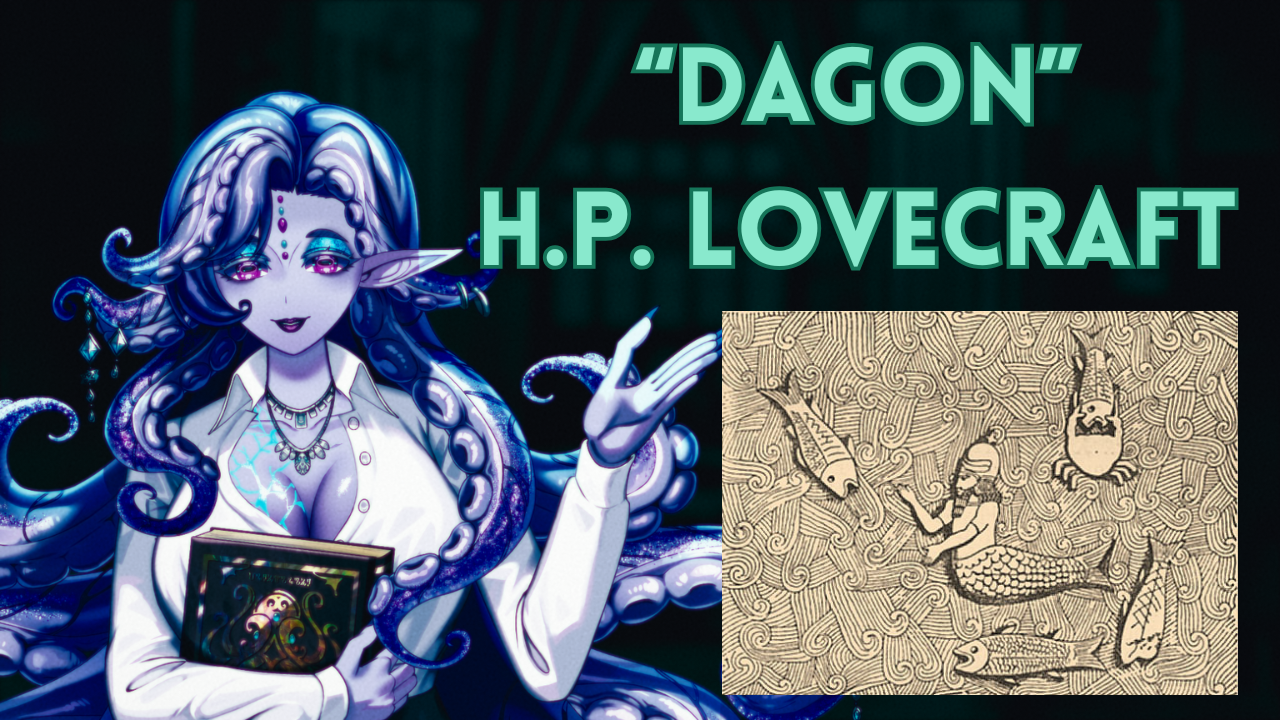
“Dagon” by H.P. Lovecraft
Considered by some the start of the Lovecraftian pantheon, it’s a story worth reading, especially if you enjoyed Junji Ito's "Gyo."

Finally, we’re getting into the (sea)weeds with Lovecraft’s “Dagon.” Howard Philips Lovecraft’s “Dagon” is perhaps his most concretely Lovecraftian story. It’s got everything — the grossness of the ocean, a weird obelisk, a narrator in a mental institution. The gaping chasm near the obelisk reminded me of the chasms in Vathek, and I like that this story leaves it open to the readers’ interpretation whether the protagonist really saw what he saw, or whether he was genuinely having visions.
A commentor on YouTube mention ‘thalassophobia’ — the fear of the deep sea — in relation to this tale. One thing that’s interesting is that the protagonist is exposed to deep sea horrors without actually taking a swim. The ocean bed rising to the floor is clearly paralleled within the text as being a parallel to a possible uprising of the Deep Ones onto land — the ocean bed being made ‘land’ through the volcanic upheaval already.
I think, like a good number of horror and science-fiction stories, the contrast between the monsters that could be at war with humanity and the humans that are currently at war with one another is meant to highlight the futility and pettiness of scale of human conflicts. We see this in the movie Arrival as well.
I wonder if Dagon had a direct influence on Junji Ito’s Gyo, given both feature the ocean rising to ‘the land’ rather than land sinking into the ocean, with oceanborne monstrosities colonizing the land (either within the text as in Gyo, or foreshadowed as in Dagon, especially in conversation with The Shadow over Innsmouth.) Both works offer social commentary and highlight humanity’s unpreparedness for dealing with a threat that, at the end of the day, is alien in nature, but not in source. Works featuring threats from the ocean feature threats from within: the Earth is mostly covered in water, after all. We are inhabitants of a water planet.
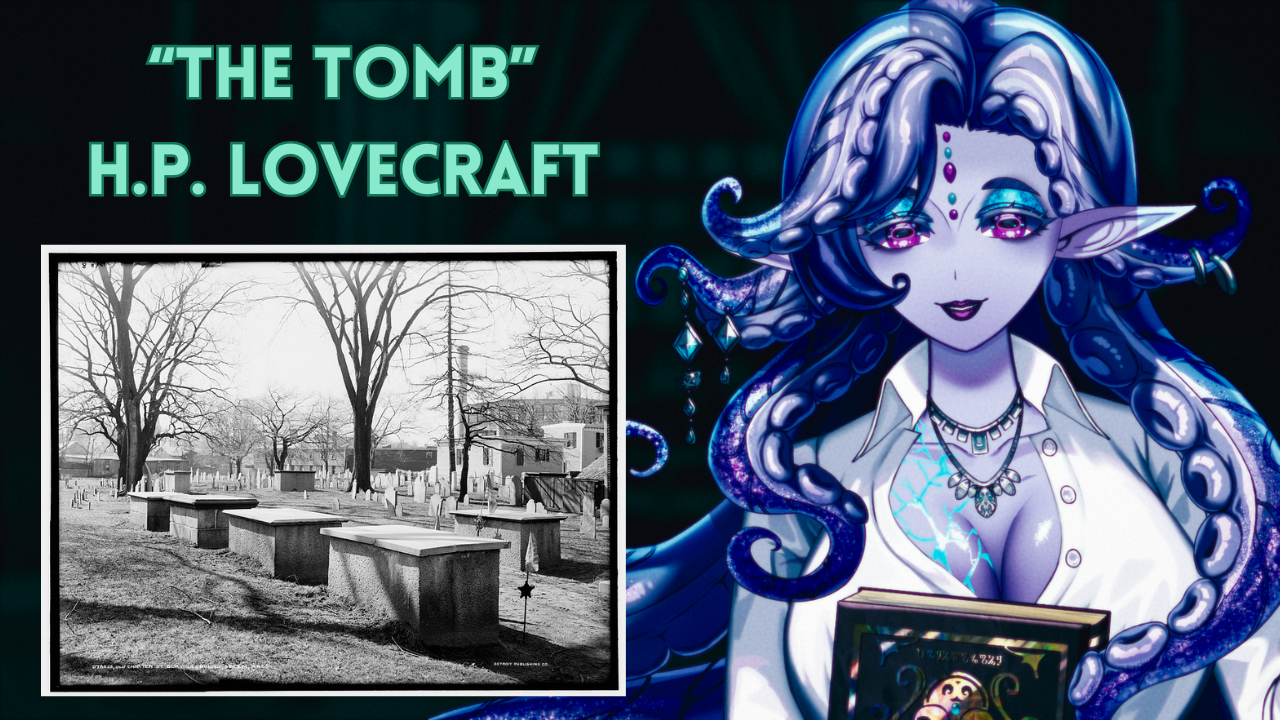
“The Tomb” by H.P. Lovecraft
This story is basically like H.P. Lovecraft’s version of “Bridge to Terabithia.” Think about it: guy has a place in the woods he goes where he fantasizes about stuff and shit does NOT end well.
NEW ENGLAND GOTHIC BAYYYYBEEE!
This story has everything. Tombs. Thunderstorms. Padlocks. Mysterious keys in attics. Porcelain miniatures. Coffins. Marble, dusted as if snapped by a Thanos coffin wielding the Infinity Gauntlet in the Marble Cinematic Universe. Boston gentry. LARPing. New England. Tombs. Protagonist who is a dweeb and lowkey a self-conscious H.P. Lovecraft self insert. A detective that actually does his job. A loyal servant. And did I mention tombs? Well, one tomb, mainly. The big one.
This story is basically like H.P. Lovecraft’s version of “Bridge to Terabithia.” Think about it: guy has a place in the woods he goes where he fantasizes about stuff and shit does NOT end well.
I hate to assign reading (no I don’t) but you should read “Supernatural Horror in Literature” by — oh, look who it is — Howard Phillips fucking Lovecraft. YEAH BUDDY.
Essentially, in the essay, Lovecraft describes the potential basis for the House of Seven Gables as “[an] object well calculated to evoke sombre reflections; typifying as it does the dark Puritan age of concealed horror and witch-whispers” and believe me when I tell you I ATE with this quote in a few essays in university.
Basically, in understanding the Gothic, it’s important to remember its roots. Horace Walpole’s “The Castle of Otranto” came out in 1764, was written around that time, and was set in a vaguely medieval time period. Gothic fiction was very rarely contemporary fiction.
A lot of people don’t really understand the word ‘contemporary’ so let me school you. ‘Con’ = with. ‘Temporary’ = having to do with time. Something that is contemporary shares a time with something. When scholars talk about Lovecraft’s contemporaries, they are talking about people who lived at the same time as him. So, a modern day author, like Joyce Carol Oates, would not be considered one of Lovecraft’s contemporaries, because they were not active in the field at the same time. Does she write Lovecraftian work? Sure, sometimes! Is it good? Well, I embarassingly haven’t read her, but most people I talk to seem to like her! But that doesn’t make her a contemporary.
Contemporary fiction is fiction that is set at the same time as its writing. So, if a book about World War II was written today, in 2025, it would not be a contemporary work, because World War II is not happening right now.
Now, there’s no rule stating the Gothic can’t be contemporary — it just tended to be historical fiction.
I mention this because this story rather adeptly blends and blurs the lines of time, if not space. Jervas’s story doesn’t contain any descriptors that, at least to my dumbass, mark it as set clearly in the distant past or in Lovecraft’s contemporary period: there’s no mention of things like telegraph machines, but it’s clearly been “generations” since 1711, and the earliest date mentioned is 1640 — the date the first(?) Hyde came to the region.
However, Jervas’s story involves clear elements that blur time: his usage of antiquated language and accents, as far back as the Puritan era but leading to the more 'modern’ (from Jervas’s perspective) and the reliving of the night of the thunderstorm that destroyed Hyde mansion.
Thus, Lovecraft manages to make a contemporary work still technically fulfil what some(who? the HATERS) might call an essential quality of the Gothic: being set in the past. The work manages to be both (relatively) contemporary to Lovecraft’s period and also skip around time periods, making it almost hyper-Gothic.
Often times, discussions of Lovecraft focus on the blurring of space, the eldritch gods, and cosmicisim, but I think “The Tomb” is an interesting piece to study given it solely focuses on dilation of time within a very confined space, limited to a single town. I like that, unlike some other works by Lovecraft, there’s room for the reader to interpret Jervas’ condition: is he truly mentally unwell and delusion? Is his resemblance, in form and name, to Jervas Hyde a mere coincidence, given he’s part of that family line?

“The Alchemist” by H.P. Lovecraft
Charles de Sorcier did nothing wrong except get caught. Also homicide.
I have an embarrassing admission. I regularly have described this story as ‘the one with the immortal wizard killing people with a gun.’ Yeah, there’s no gun. I don’t know why I thought there was a gun. There isn’t one.
Written in 1908, Howard Phillips Lovecraft would’ve been 17 or 18 years old when he wrote “The Alchemist.” This may or may not count as juvenilia. There’s a 9 year gap between 1908’s “The Alchemist” and the next Lovecraft work I’ll be covering, “The Tomb.”
Unpopular opinion: I think this story was ‘worse’ than “The Beast in the Cave.” “The Beast in the Cave” featured clear character growth and in a shorter timeframe. That said, Antoine, the protagonist of “The Alchemist,” shares a lot of traits with Lovecraft. Both were loners. Both lost their fathers at early ages. Both were raised by older men: Antoine’s Pierre, Lovecraft’s grandfather Whipple Phillips (what a name.) Both were from families that had significant financial troubles. Both were interested in older texts and the occult.
Obviously, there’s parallels drawn between Charles and Antoine that are made obliquely apparent as soon as Charles and curses’ backstory is revealed. However, there’s a third fatherless young man related to the text: H.P. Lovecraft, whose father died at a very young age. Lovecraft’s father, Winfield Scott Lovecraft,was institutionalized when Lovecraft was only 3, and died when Lovecraft was 5. Winfield was around 40 at the start of his instutionalization and died at age 44. I think the dynamic between Charles and Michel was interesting, and wonder if it reflects the feelings Howards Phillips Lovecraft had about his own father. Or, did Lovecraft identify more with Antoine: both of them bookish types, not exactly prone to violence?
This is Lovecraft’s first story featuring a clearly Gothic castle. There’s clearly a lot of Gothic language used: technical descriptions of parapets, the tracing of family lineage and events back to the medieval era. The stones falling from the parapets are very reminiscent of the helmet in The Castle of Otranto. I’d say it’s pretty sick fucking nasty.
I do think Charles de Sorcier was right to call the protagonist low-key kinda dumb. The protagonist knew Charles was studying alchemy. He knew Charles was trying to find an immortality elixir. The protagonist literally questions how Charles’ mission could’ve continued past the lifespan of a normal human being. It doesn’t take a genius to figure out Charles invented an elixir. Yet again, it’s another Lovecraft detective story where the detective (Antoine) stumbles upon the answer to a mystery through exploration rather than investigation. If Antoine had a Steam account, he would be the type of person that serendipitously achieves extremely rare and niche achievements in Pardox Games, entirely without intending to do so.
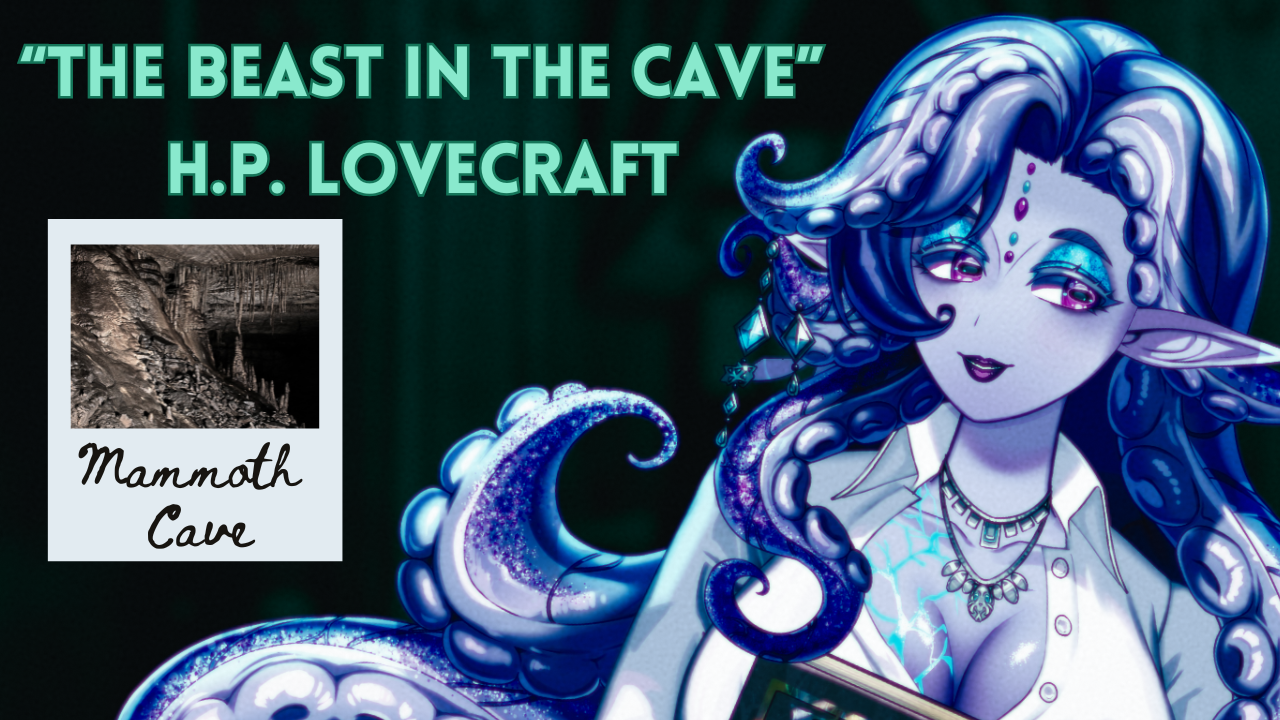
“The Beast in the Cave” by H.P. Lovecraft
Fun fact: Lovecraft was only 14 when he wrote this story! Did you see the twist coming?
Lovecraft was born in August of 1890. The manuscript is marked with the date “4/21/05,” meaning Lovecraft was still 14 when he wrote this story. It’s a very impressive fiction for a teenager to have written.
This is the first Lovecraft story featuring a monster…or is it? It is certainly his first work featuring the stereotypical Lovecraftian themes and language we associate with the author, as opposed to his earlier juvenilia, which is more pulp/adventure/detective influenced. It’s his first story written in a first person perspective. It’s his first story in which a monetary amount or a treasure is not present. It was also his longest work to date. It’s impressive his writing improved so much in just 2-3 years. Compare the text of “The Mysterious Ship,” written in 1902, to “The Beast in the Cave.”
It’s Lovecraft’s first story featuring an underground society (the “consumptives.”) Consumption is an old-timey word for tuberculosis, and there really was a consumption sanatorium in the Mammoth Cave system. I’m surprised Lovecraft knew about this, given the sanatorium was from the 1840s and in Kentucky, and he was a kid living in the late 1800s/early 1900s Rhode Island. I wonder if this sanatorium was the thing that inspired his other subterranean societies, especially the one features in “The Rats in the Walls.”
It’s his first work featuring usage of language like “grotto,” “sepulchre,” and “ghastly,” which are common in works in the Gothic mode.
I’m surprised that Lovecraft didn’t draw parallels between his protagonist’s assumption that the beast was feline and the story of Daniel and the lion. Both stories feature men stuck underground or in caves with big cats. Maybe he was leaving it up to the reader to draw that parallel, or maybe it was just a coincidental choice of animal.
It is also the first story in which we see the mental state of a character decline. Lovecraft does a great job of establishing the character as someone who believes they are rational and logical, with the protagonist bragging about having an “unimpassioned demeanor,” the same protagonist who describes himself as later “gibbering” and admits having had a “boasted reserve” at the start of the story. The character has a great capacity for self-reflection. However, the protagonist does not end up in a mental institution and doesn’t seem to have sustained any permanent damage from his adventure in the cave. He’s just taken down a peg.
The “beast” obviously acts as a sort of foil to the main character but also begs the question: was the “beast” really looking to kill the protagonist? The actions of the beast, following sounds through a cave to a reach a person, mirror the actions of the protagonist, who follows the guide’s sounds to find the guide in the cave. Technically, what the protagonist engaged in was just an act of murder, given the beast never actually attacked the protagonist. That also makes this Lovecraft’s first story with a murderer for a protagonist.
I know that the Fandom page lists the beast as an example of devolution in the works of Lovecraft. I think it’s an edge case. It might be atavism (another term for devolution.) But, the “beast” having a large black pupils? That’s what happens to anyone who has been down in the dark for a long time. Getting white hair? Being thin? That’s called getting old. Devolution involves transformation. We do not actually see the “beast” transform. We only saw it once. There’s no other reference points for its appearance that would link it to devolution. If there were animal traits on the person, like a tail, or gills, or scales, sure, let’s call it devolution. But it’s not clear here.